

This excellent tweet from Mike Isaac at the New York Times prompted one of the better group chats that I am in to discuss the negative societal consequences of the isolated life necessitated by a suburban existence. Naturally, I saw this as an opportunity to tout the work of Henry George, and in doing so, I was reminded how few people are familiar with something most economists consider the best possible tax: one on land value.
To clear up the usual confusion, a land value tax (LVT) is very different from the property taxes the roughly 65 percent of Americans who live in property-owning households know and don’t especially love. The distinction requires explaining what real estate assets actually are: a combination of a depreciating good (whatever is built on the land) and an appreciating asset they aren’t making more of1 (the land). Most property taxes tax both, but an LVT only taxes the land.
While the difference seems small, it has massive implications. Under a traditional property tax system, if you own a vacant lot in a desirable neighborhood, and you’re thinking about developing it, you know that building something will increase your property taxes. So there’s this built-in disincentive to development. Under an LVT, your taxes are based on the land value regardless of what you do with it. So if you’re sitting on a valuable vacant lot, you’re paying the same taxes as if you’d built a skyscraper on it. Which means—and this is the key part—you have a strong incentive to actually build the skyscraper! Or at least something productive. Because otherwise you’re just hemorrhaging money on taxes2 for an empty lot.
This simple change in incentives produces spectacular results. Especially in light of some of the most pressing challenges we face as a country today: the housing shortage and unsustainable national debt. While those problems do not seem linked, as the members of the subreddit r/georgism are so fond of saying, “a LVT solves this.”
Starting with the housing shortage, and working from the assumption that local efforts to block construction (NIMBYism) is the main cause of it, the current property tax system incentivizes that behavior. Keeping the improvements the same moderates the rate of property tax increases, even as the shortage of land raises land values. This structure creates powerful incentives for existing homeowners—especially older, whiter and richer ones—to engage with the local planning process to prevent new construction. While it is in the interest of existing homeowners to utilize scarcity to raise the value of what is almost certainly their largest asset, the micro and macroeconomic consequences are drastic.
When housing is blocked, communities suffer. People need places to live, and with all other avenues blocked, the result is sprawl. As a child of the suburbs, I can say that there is value in the experience, but there are massive social and economic costs. Socially, when driving becomes the only feasible means of moving around (especially for families), isolation is a natural consequence. And when housing is in such short supply, the economic proposition of a “third place” stops making sense.
To suburbanites, the costs of sprawl are also massive. Not only is driving everywhere expensive, but the costs of building and maintaining infrastructure for the same number of people over a larger area is pretty negative (as this graphic from Halifax’s Regional Municipality below shows).

On a national scale, the consequences are even more dramatic: Hsieh and Moretti (2019) find that between 1964 and 2009—before the more restrictive lending standards to buyers and builders accelerated the housing shortage—housing restrictions in New York, San Francisco, and San Jose cut real income per worker growth in half. The commonly cited counterfactual from their paper—in which those cities did not have overly restrictive housing construction policies—was an increase in national income of between 3.7 and 8.9 percent, depending on the overall mobility of labor. That is primarily due to the cuts to aggregate productivity growth due to workers not being able to move to these dynamic cities, and access agglomeration effects they provide. For more on this, I recommend Moretti’s book, The New Geography of Jobs.
That sort of change in productivity growth is pretty striking. As Paul Krugman so adeptly noted, productivity growth really is the most important determinant of long term growth. Working from the baseline of productivity growth boosted by Hsieh and Moretti’s work, the power of compound interest is such that less NIMBYism would leave us in a dramatically better place today.
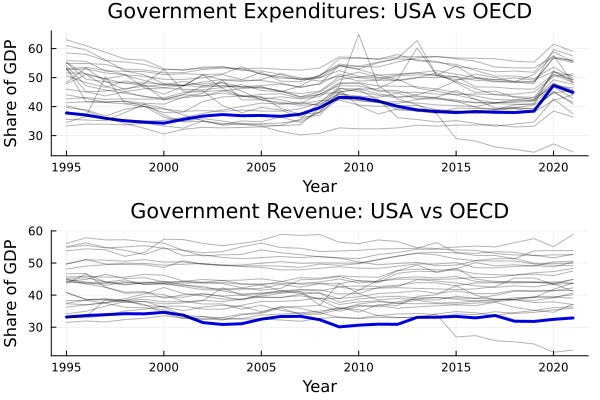
In addition to the productivity-boosting effects of disincentivizing NIMBYism, a LVT could have another benefit: boosting revenue. As Jordan Weissmann unfortunately noted, anti-tax extremists seem to have won the messaging battle over income taxes (at least for the short term), and as a result, despite the fact that the United States spends less than many of its OECD peers, it’s revenue collection is even more anemic.
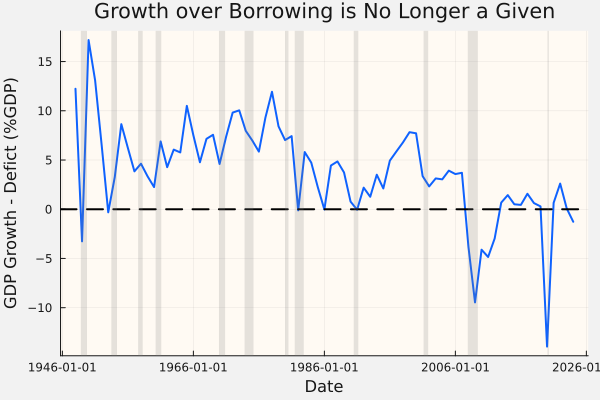
As a result, the debt is becoming unsustainable. The easiest way to think of debt’s sustainability is to if national income is growing faster than the debt load. In the plot below, I show that following the Second World War, that was broadly true until the Great Recession. It stands to reason, therefore, that the best way to improve the sustainability of the debt would be to boost growth and cut the deficit. With limited appetites to raise income taxes, and limited room to cut spending without drastically reducing Americans’ quality of lives, a LVT could have substantial benefits. By disincentivizing NIMBYism, it boosts growth, and it could be expected to raise substantial revenue.
The revenue potential from a LVT should not be discounted. Even assuming a deduction structure where state and local land value (but not improvement taxes) were deductible from it, a five percent rate on land value worth between 125 and 150 percent of GDP (a decent estimate) could raise between 6.25 and 7.5 percent of GDP as revenue annually. Assuming localities phased out taxes on improvements to take advantage of those deductions, that revenue, minus the roughly 2.6 percent of GDP collected by local entities in this program would be enough to bring the deficit under control in the long run. In fact, it could even prove lucrative enough to support a more generous social safety net.
An LVT would not replace the need for income, payroll, corporate profits, or capital gains taxes, but it could dramatically improve our national life. It addresses housing affordability by removing the tax penalty on development, encourages denser and more sustainable communities, unlocks significant productivity gains, and generates substantial revenue—all while taxing an asset that, unlike labor or capital, cannot flee to lower-tax jurisdictions.
Therefore, I find it vital that we start raising it in more concrete policy discussions. The technical details matter, the political obstacles are real, but the potential benefits are too large to ignore. If we’re serious about addressing housing affordability, productivity growth, and fiscal sustainability, a land value tax needs to be part of the conversation.
At least until we do something about the Foreign Dredge Act of 1906
To be clear: the land value would still go up if you and everyone around you builds stuff, because that makes the neighborhood more valuable. But your development doesn’t increase your taxes, except indirectly through this general area effect. Which is different from “build anything and your taxes immediately jump.”